
Teaching AI Our Languages: Building for Sinhala and Tamil
Most AI is built for English first. Closing the gap for Sinhala and Tamil speakers is a challenge Sri Lanka's own engineers are best placed to solve.
September 2026 · 4 min read
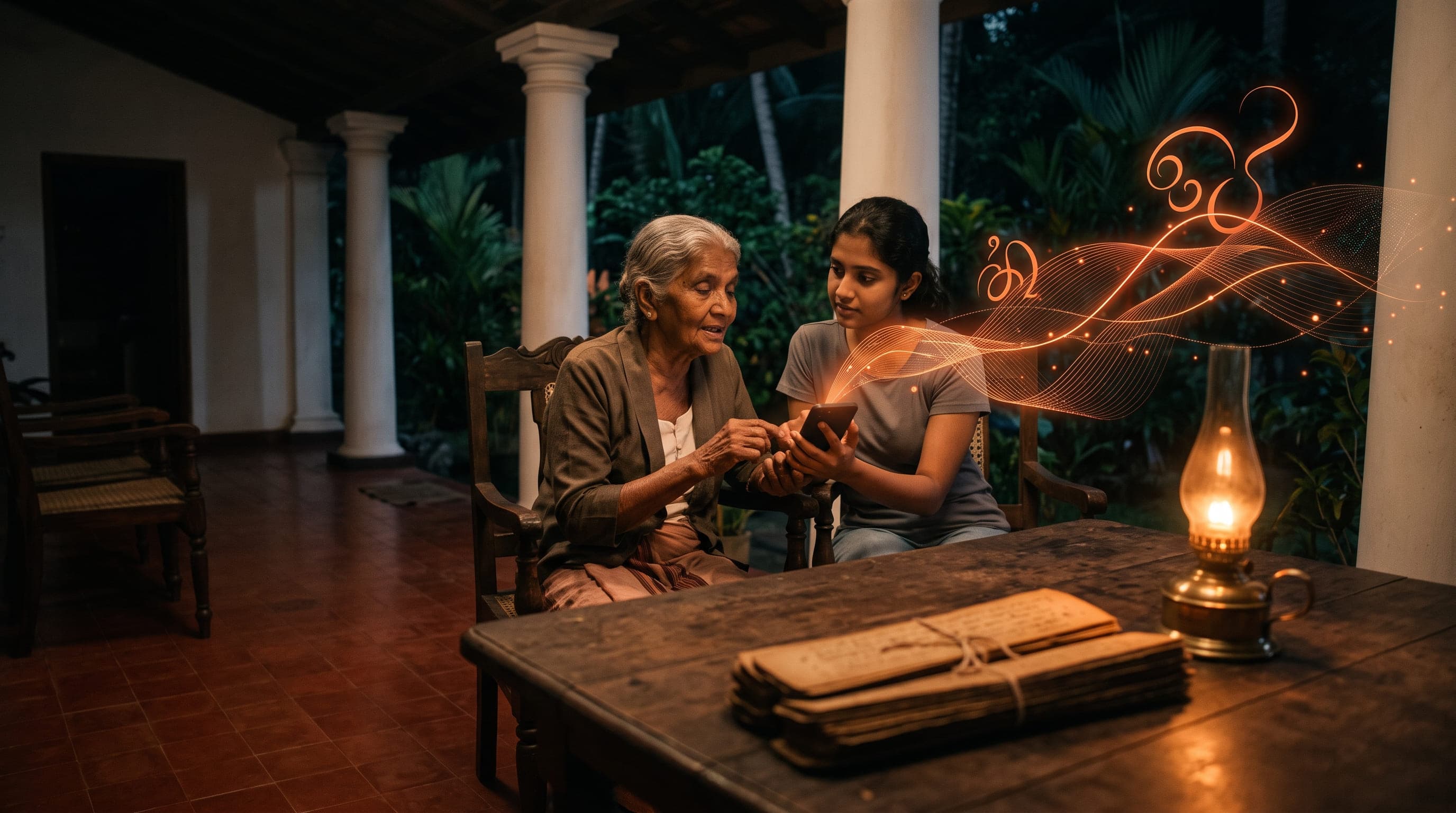
Ask a popular AI assistant a question in English and you will usually get a fluent, confident answer. Ask the same question in Sinhala or Tamil and the experience can be noticeably different: awkward phrasing, misunderstood idioms, or answers that slip back into English halfway through.
This is not because these languages are harder in some absolute sense. It is because of data. Large language models learn from the text that exists online, and that text is overwhelmingly English. Languages with fewer digital resources, often called low-resource languages, are left with weaker models, and their speakers get less from the AI revolution.
For Sri Lanka, that gap is not an abstract research problem. It decides who can use AI-powered services in their mother tongue, and who gets left behind.
Why local languages are hard for today's models
- Limited training data: compared with English, there is far less high-quality Sinhala text online, and Tamil, while widely spoken, is still underrepresented relative to its number of speakers.
- Tokenization: models split text into pieces called tokens, and many tokenizers were designed around English. Non-Latin scripts are often broken into many more tokens, which makes processing slower and more expensive and leaves less room in the model's context.
- Code-mixing: real conversations constantly blend languages, mixing English with Sinhala or Tamil, and are often typed in Latin letters rather than the native script. Models trained on clean, single-language text struggle with this.
- Spoken and written forms: Sinhala in particular has notable differences between its formal written style and everyday spoken language, so a model that sounds natural in one can sound stiff or odd in the other.
- Few evaluation benchmarks: it is hard to improve what you cannot measure, and good test sets for local languages are still scarce.
Why it matters
Language is access. If government services, health information, agricultural advice and educational content are increasingly delivered through AI, then people who are most comfortable in Sinhala or Tamil must be served just as well as English speakers. Otherwise AI risks widening existing gaps between urban and rural communities, and between those who are fluent in English and those who are not.
An AI that does not understand the way people actually speak is an AI that will not be trusted, or used, by the people who need it most.
There is also an economic argument. Products that work well in local languages can reach millions of users that global companies tend to overlook, which is a genuine opening for Sri Lankan startups and researchers.
What actually moves the needle
The good news is that the tools to close the gap are more accessible than ever. Modern multilingual models already carry some knowledge of Sinhala and Tamil, and they can be improved substantially through fine-tuning on smaller, carefully chosen datasets. Speech recognition and text-to-speech systems can likewise be adapted with hours, rather than thousands of hours, of quality recordings.
What matters most is the quality and authenticity of the data:
- Text that reflects how people really write, including informal and code-mixed messages, not only formal documents.
- Speech recorded from speakers of different ages, regions and accents.
- Evaluation sets written and reviewed by native speakers, so progress is measured honestly.
- Clear licensing and consent, so the resulting datasets can be shared and built upon by others.
How students can contribute
This is one of the few areas of AI where a Sri Lankan student has a natural advantage over a large overseas lab: you speak the language and understand the culture. There are many ways to put that advantage to work:
- Build and openly publish small, high-quality datasets for a specific task, such as sentiment, question answering or named entities.
- Benchmark existing models on Sinhala and Tamil tasks and share the results, including where they fail.
- Fine-tune open models for a practical local use case and document what worked.
- Contribute to open-source language tools such as tokenizers, spell checkers and transliteration systems.
- Make your final-year or research project about a local-language problem. It is meaningful, publishable and badly needed.
A shared responsibility
No single company or university will solve this alone. Progress will come from a community of researchers, engineers, linguists, educators and everyday speakers each adding a piece. The more of that work happens openly, the faster everyone moves.
AI that truly serves Sri Lanka has to speak like Sri Lanka. Building it is a challenge, and an opportunity, that belongs to this generation of local engineers.